 Before Sunrise
It Tastes Like an Energy Drink, and There Is No Caffeine in It
Focus Brain is a Swiss pocket spray, five presses once a day, flavored like a can from a cooler. I read its label under my kitchen lamp before sunrise, beside the coffee that does carry caffeine.

This is a paid advertisement. Sponsored by EnergyBalance SA.

The lamp on my kitchen table goes on at twenty to six, most mornings, before the furnace kicks in and before anyone else in the house is awake.
It is a small lamp with a cream shade, and it makes a circle of yellow light on the wood about the size of a dinner plate.
Inside that circle, every morning, there is a mug of coffee.
Nothing else has earned a place there in eleven years.
This month something tried.
It was a small white spray bottle from a company in Switzerland, and the side of its box said it had an energy-drink taste.
A little further down, the same box said Caffeine-Free.
I have never drunk an energy drink in my life.
I know men who have, mostly on long night drives, and I know the cans by their colors in the cooler at the gas station.
What I could not work out, at twenty to six with the lamp on, was why anyone would want the taste of one without the one thing it is built around.
A taste is a promise about a drink. I wanted to know what this one was promising.
So I did what I usually do with a label I do not understand.
I read every line of it, in order, and I wrote down what each line weighs.
Then I set each number next to the one thing I already understand very well, which is the mug.
This is that reading.
It is long, because the label is short and it deserves a slow look, and the first hour of the day is a good time for a slow look.
The First Hour Belongs to the Coffee
If you are up before the sun, you already know the shape of this hour.
The dark window, the tick of the kitchen clock, the smell of the pot before it finishes.
Most of the men I know who keep this hour have kept it for decades.
It started with a job that began early, and the job ended, and the hour stayed.
For most of them, the hour has one tool, and it comes in a mug.
Coffee is the stimulant most of us know by heart.
We know how many cups we take, at what time, and what happens when we skip one.
We also know, whether we say it or not, that coffee is not really a flavor to us.
It is a job the cup does.
You could give me a decaf that tastes exactly the same, and I would know by nine o'clock.
That is the useful thing to hold onto while reading this label.
With coffee, the taste and the work arrive together, and we have stopped telling them apart.
With this Swiss spray, they arrive separately.
The taste is borrowed from one kind of drink, and the work, whatever there is of it, comes from a very short list of other things.

How Much Caffeine the Mug Already Carries
Before looking at what the spray leaves out, it helps to put a number on what the mug puts in.
The Food and Drug Administration gives a range for a 12-ounce cup of brewed coffee: 113 to 247 milligrams of caffeine. [1]
That is a wide range, and it depends on the beans, the grind and how long the water sits with them.
The same agency cites 400 milligrams a day, about two to three of those cups, as an amount not generally associated with negative effects in most healthy adults. [1]
Europe's food safety authority came to a similar place in 2015.
It found that single amounts up to 200 milligrams and daily totals up to 400 milligrams did not raise safety concerns for healthy adults. [2]
That same European opinion says something I found more interesting.
It states plainly that caffeine in moderate amounts increases alertness. [2]
So the thing we feel from the mug has a name, a measured amount and an official sentence behind it.
It is not in your head, and it is not just habit.
Too much has its own list, and the FDA spells it out: a faster heartbeat, jitters, an upset stomach, a headache, a poor night. [1]
Most men our age have learned their own limit on that list the hard way, usually around the fourth cup.
The mug does real work, and the work has a number. Keep the number in mind.
Because the first thing to know about this Swiss spray is that its number, on that line, is zero.
What a Can From the Cooler Is Built Around
I walked past the cooler at the gas station on my way back from the hardware store and looked at the cans for a while.
Tall ones, short ones, black ones, silver ones, some with lightning on them.
The backs of those cans are more honest than the fronts.
When you turn them around, caffeine is almost always near the top of the list, with sugar or a sweetener close by.
Many of them also print taurine, an amino acid whose name has become part of the category.
Taurine has been tested on its own.
A 2025 review that pooled seven randomized trials, 402 people in all, found no significant effect of taurine on scores on thinking tests, whether it was taken alone or with exercise. [3]
So of the three things a can is built around, one has an official sentence about alertness, one is sugar, and one came out even when it was measured.
The taste that ties them together is something else again.
It is sweet, a little sour, a little like fruit that does not exist in nature, and bright on the tongue.
That taste is what the Swiss company borrowed.
It borrowed the flavor of the can and left the can's contents on the shelf.
Whether that is a clever idea or a strange one depends on what you wanted from the can in the first place.

Water Before the Second Cup
Here is something the circle of lamplight usually does not hold, and probably should.
A glass of water.
After a night without drinking, many of us start the day a little dry, and the first thing we pour is coffee.
A large German study followed 1,111 adults between 60 and 89.
About a third of them were measurably short of water, and that group slipped faster on a test of processing speed over time than the others. [4]
That study found an association, not a cause.
It tested nothing you can buy.
A 2021 review of 18 studies in adults over 60 came to a careful version of the same place.
There is some evidence, though sparse, linking being short of water to poorer performance on thinking tasks. [5]
A glass of water costs nothing and takes ten seconds.
If you want one change to the first hour that has any evidence behind it at all, it is probably this one, before the second cup.
I mention water early for a reason.
The Swiss spray is mostly water, and it will help to remember that when we get to its list.
Why a Man Reaches for Something at Breakfast
I have asked myself why a small bottle with a borrowed flavor would appeal to men like us at all.
I think the answer has less to do with chemistry than with habit.
Men who keep an early hour tend to like small rituals.
The same mug, the same chair, the same order of things.
A ritual is a kind of reminder.
It tells the rest of the day that the day has started.
Some men add a vitamin to that ritual, some add a walk around the block, some add the crossword.
None of those has to be tested in a laboratory to earn its place, because each one marks the hour.
A spray that fits in a shirt pocket and takes ten seconds is built to slide into that kind of ritual.
It is designed around the gesture as much as around the contents.
That is fine, as long as a man knows which part he is paying for.
If he is paying for the gesture and the taste, he should know the numbers are small.
If he is paying for the numbers, he should know how small, and I will get to exactly how small.
A morning ritual is worth having. It is worth knowing what is in it.
Reading a Label the Way You Read a Recipe
Food labels in most of the world follow one simple rule that is worth remembering.
The ingredients are listed by weight, from most to least.
The first word is the thing there is the most of, and the last word is the thing there is the least of.
Recipes do the same thing, more or less.
If flour comes first and vanilla comes last, you know roughly what kind of cake you are making.
Labels also tend to separate two kinds of line.
There is the plain list of ingredients, and there is a smaller box that gives amounts for the ones the maker wants to count.
With this spray, the plain list has eight entries.
The box of amounts has four.
Between those two, you can learn almost everything a buyer needs to know.
You do not need a laboratory, just a pencil and the lamp.
What the Word Energy Means on a Food Label
Before going further, one word on the box needs untangling, because it does a lot of quiet work.
The word is energy.
In ordinary talk, energy is a feeling.
It is the difference between the man who gets up and clears the gutter and the man who looks at the gutter from the window.
On a food label, energy means something far duller.
It means calories, the fuel in food, and the chemistry the body uses to turn that fuel into something it can spend.
European rules have a phrase for that chemistry: "normal energy-yielding metabolism." [6]
Several vitamins are allowed to carry that phrase, because they take part in the process in every one of us.
None of that is the feeling at nine in the morning.
A vitamin taking part in the chemistry of calories is not the same thing as a man feeling ready for the gutter.
The cans in the cooler blur this on purpose.
Their energy is mostly the caffeine you feel and the sugar you burn, and the word on the front covers both.
When a label says a flavor tastes like an energy drink, it is borrowing the feeling of the word without the contents behind it.
That is worth noticing, even when nothing on the label is untrue.
Keep the two meanings apart as you read on.
Where I say energy from here, I will say which one I mean.
Sweet, With No Sugar Bowl in Sight
The second thing a can from the cooler brings is sweetness, and most of us have strong habits about sweetness at breakfast.
Some men take two sugars in their coffee and have for fifty years.
Some quit sugar in the coffee after a checkup and never went back.
Food makers have spent decades on ways to make things sweet without sugar.
One family of these sweeteners is called sugar alcohols, a confusing name, because they contain no alcohol of the kind in a beer.
They are made from plant material, and some of them taste very close to sugar.
You have met them in sugar-free chewing gum and mints, even if you never read the wrapper.
The Swiss spray is sweetened with one of them, and I will come back to it, because it carries one caution that matters more than any other line on the label.
For now, the point is simpler.
The sweetness in this bottle does not come from sugar, and the label says it holds none.
The Flavor Weighs Almost Nothing
Here is a small fact about taste that surprised me when I first learned it, years ago, from a man who worked for a soft-drink bottler.
The flavor of a drink is usually one of the lightest things in it.
A few drops of flavoring can decide what a whole bottle tastes like.
That is why flavorings sit near the end of an ingredients list.
They weigh very little, and they do almost all the talking.
It is also why a drink can taste like one thing and contain something quite different.
The tongue reads the flavor first and the rest of the list never.
On this spray's label, the flavoring is listed sixth of eight.
It sits after the two plant extracts and before the citric acid and the vitamin.
So when the box says energy-drink taste, it is telling you about a line near the bottom of the list.
The lines near the top are water and a sweetener.
The tongue reads the flavor and the label reads the weight. Trust the label.
The Hour After the Coffee
By half past eight, the lamp is off and the kitchen is full of daylight.
This is the hour when a man finds out what the first cup was worth.
Most of us are not looking for fireworks at that hour.
We want to read the paper and remember what we read, find the car keys, make the call we meant to make.
Steady is the word most men I know would use.
Not wired, not racing, just able to get on with things.
That is a modest thing to want, and it is an honest thing to say about what we want from a bottle.
It is also a long way from what the cans in the cooler are built to deliver.
A can is designed for the night shift and the long drive.
The man at the kitchen table at half past eight usually needs something much quieter.
I mention it because a flavor that says energy drink can pull a man's expectations in the wrong direction.
If he tastes the can and waits for the can's effect, he is waiting for something that is not in the bottle.
The Small Shelf Most of Us Already Keep
Open a kitchen cabinet in the home of almost any man over sixty and you will find a small shelf of bottles.
A multivitamin, maybe fish oil, maybe something from the pharmacist, maybe something a daughter recommended.
That shelf tends to grow one bottle at a time, and it rarely shrinks.
Each bottle was bought for a reason, and the reasons are often forgotten a year later.
A new bottle should earn its place on that shelf, the same way the mug earned its place in the circle of lamplight.
The honest way to judge any new bottle is to ask three plain questions.
What is in it, how much, and what the research used when it tested the same things.
There is a fourth question, and it matters more after sixty than before.
Does anything already on the shelf argue with what is in the new bottle?
That one is not for a label to answer, or for me.
It is for the pharmacist, who can read every bottle you own in a few minutes if you bring them in a bag.
Keep that bag in mind.
It will come up again near the end of this reading, and it is the cheapest advice on this page.
A Spray Is an Odd Shape for Breakfast
Most of what we take in the morning comes in a mug, a bowl or a glass.
A spray is a stranger shape for the first hour, and it is worth a moment on its own.
The sprays most of us have used are for the breath or the throat.
A quick press, a cool taste, and it is gone before you have put the bottle down.
Nothing to swallow, no glass of water, nothing to chew.
For a man who dislikes swallowing anything larger than a coffee bean, that alone has some appeal.
The gesture is also quick and private.
It can happen at the kitchen table, in the car before the engine starts, or in the hallway with your coat half on.
But the shape of a spray sets a hard limit on how much it can carry.
A few presses deliver a few drops, and a few drops can only hold so much of anything.
That limit is the single most useful thing to know before reading the numbers on any spray, this one included.
When the amounts turn out to be small, it is not sleight of hand by the label; it is the physics of a few drops.
Keep that in mind, the way you keep the mug's caffeine in mind.
The two together will make every figure on the panel easier to read.
A Bottle From the Shore of Lake Maggiore
The bottle comes from EnergyBalance SA, a company in Muralto, a small town on the shore of Lake Maggiore in the Italian-speaking part of Switzerland.
The company says it has been making supplements for more than twenty-five years, and that it develops and produces them in its own facilities in that corner of the country.
Those are the company's own statements, and I report them as such.
The product is called Focus Brain.
The name is the company's, and I use it because that is what is printed on the box, not because I think the name tells you what the bottle does.
It is sold in Europe as a food supplement.
In the United States, a product like it would be sold as a dietary supplement.

The bottle holds 25 milliliters, which is a little under a fluid ounce.
That is about the height of a marker pen, and it is meant to ride in a shirt pocket or a coat.
The label says the bottle holds about 150 presses.
The daily amount is five presses into the mouth, once a day, which makes the bottle last about a month.
I put the box under the lamp and turned it slowly.
The panel is partly in German, because the company sells across Europe, and partly in English.
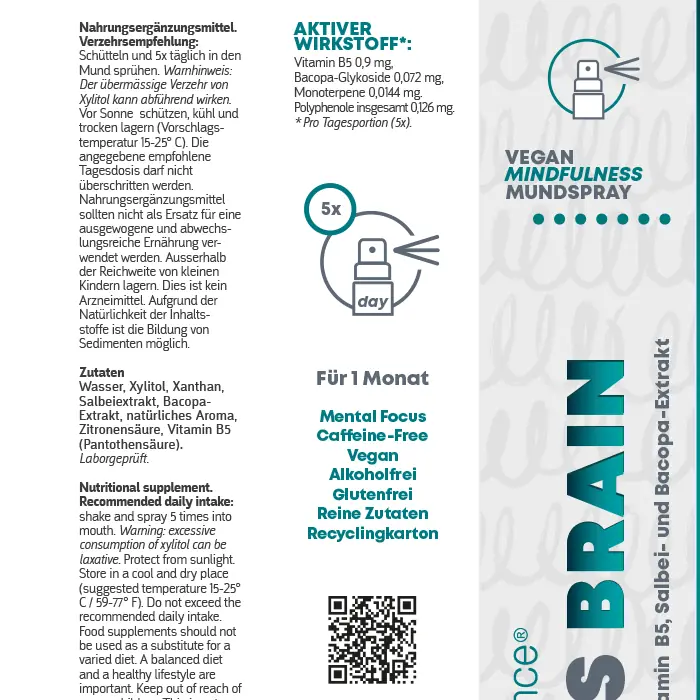
On the front, in green: Mental Focus, Caffeine-Free, Vegan.
On the side, a small line in English describes the spray as one "to go with energy-drink taste."
So there it was, printed by the company itself.
The taste of the can, and no caffeine in the bottle.
The box tells you the taste and the panel tells you the contents. Those are two different sentences.
Eight Words, in Order of Weight
Here is the full list of ingredients from the label, in the order the company prints it.
Remember the rule: most first, least last.
- Water
- Xylitol, a sweetener
- Xanthan gum, a thickener
- Sage extract
- Bacopa extract
- Flavoring
- Citric acid
- Vitamin B5, also called pantothenic acid
Read that list the way you would read a recipe, and a picture appears quickly.
This is a lightly thickened, sweetened water, flavored and made tart, with small amounts of two plant extracts and one vitamin.
There is nothing wrong with that picture.
It is simply a different picture from the one the word energy draws.
Notice what is not on the list.
There is no caffeine, no sugar, no alcohol, and no taurine.
Every one of the four things a can from the cooler is built around is either missing or replaced.
The caffeine is gone, the sugar is swapped for xylitol, the taurine is absent, and only the taste stays.
The company also prints that the product is vegan and contains no gluten, and that sediment may form because of what is in it.
Shake it, the label says, before you press.
Water Comes First, as in Most Drinks
The first word is water, as it is in nearly every drink you have ever bought.
That surprised me less than it might surprise you, because a spray has to be liquid to spray.
It is worth saying plainly, though.
Most of the twenty-five milliliters is water, the same thing that comes out of your kitchen tap.
Five presses of it are a few drops.
They will not do the job of the glass of water I suggested earlier, and nobody should think of them that way.
If anything, the first line of the label is a small reminder to pour the glass.
The glass holds about a hundred times as much water as a day's five presses, give or take.
The first word on the label is water. Let it remind you of the glass.
Xylitol, and the Dog Under the Table
The second word, and so the second heaviest thing in the bottle, is xylitol.
It is the sugar alcohol I mentioned earlier, the one that sweetens so much sugarless gum.
Xylitol is made from plant fiber, often from birch wood or corn cobs.
It tastes close to sugar, and it is what gives the spray its sweetness without sugar.
The label carries its own caution about it.
Too much xylitol can have a laxative effect, which is one good reason never to press past the daily five.
The more serious caution is not about you at all.
It is about the dog.
The Food and Drug Administration cautions that xylitol is absorbed quickly in dogs.
It can trigger a strong release of insulin and a rapid, deep drop in glucose, within 10 to 60 minutes. [7]
In people, the same agency notes, xylitol does not stimulate the release of insulin. [7]
So the sweetener that is harmless enough in your mouth is a real hazard to the animal asleep under the kitchen table.
If you keep a dog, handle this bottle like the pack of sugarless gum.
It goes somewhere high or closed, never on the low table, never in a coat left on a chair.
I have a neighbor with a young beagle who eats anything that falls.
When I told him about this line, he said he had never once looked at what sweetened his gum.
Most of us have not.
This is a good reason to start, with this bottle and with everything else on the counter.

The Gum and the Sour: What Makes It a Spray
The third word is xanthan gum, and it has nothing to do with chewing gum.
It is a thickener, made by fermentation, and you have eaten it in salad dressings and sauces for years.
In a spray, a thickener helps the liquid hold together as a fine mist and keeps what is suspended in it spread through the bottle.
It is part of the machinery of the spray, not part of what the spray is for.
Near the end of the list comes citric acid, the sourness of lemons.
It gives the flavor its bright edge and helps keep the liquid stable.
Put the sweetener, the gum, the flavoring and the citric acid together, and you have the whole of the energy-drink taste.
Four of the eight ingredients exist to make the spray taste and behave the way it does.
Of the remaining four, one is water.
That leaves three lines, and those three lines are where any case for the bottle has to be made.

The Four Lines That Carry a Number
Below the ingredients, the label has a small box, headed in German, that gives amounts for five presses together.
There are four lines in it.
- Vitamin B5 (pantothenic acid): 0.9 milligrams
- Bacopa glycosides: 0.072 milligrams
- Monoterpenes, from the sage: 0.0144 milligrams
- Total polyphenols, from the two plant extracts: 0.126 milligrams
The first line is a vitamin, weighed directly.
The other three are marker compounds, which are chemicals used to measure how much of a plant extract is present.
The label does not print how much sage extract or bacopa extract the bottle holds, only these markers.
That makes the herbs harder to compare with the studies, but not impossible, and I will try.
One more thing about that box.
The company's own web listing prints the sage line as 0.144 milligrams, ten times the label's figure.
I follow the label, because the label is what comes in the box.
If you buy, it is worth writing to the company and asking which figure is right.
Point Nine of a Milligram, and the Sentence It Allows
Start with the vitamin, because it is the only line on the label with a sentence attached.
Vitamin B5 turns up in almost every food, from eggs and milk to mushrooms, whole grains and avocados.
The body uses it to turn food into usable fuel, the calorie kind of energy.
The US Daily Value for it, the number printed on American labels, is 5 milligrams. [8]
Europe uses a reference value of 6 milligrams. [9]
The spray's 0.9 milligrams is 18 percent of the American figure.
It is exactly 15 percent of the European one, and 15 percent is the line at which European rules count an amount as significant. [9]
That is not an accident of arithmetic.
Above that line, Europe allows a label to print a small set of approved sentences about the vitamin, word for word from an official list. [6]
The sentence the company chose reads: "Pantothenic acid contributes to normal mental performance." [6]
Europe also allows sentences about the reduction of tiredness and about normal energy-yielding metabolism, and the label uses those too. [6]
The operative word in every one of those sentences is "normal."
They describe what the vitamin does in everyone who gets enough of it, not an improvement for a man who already does.
The Word Tiredness, and What It Is Not
The European sentence about tiredness deserves a closer look, because it is the one most likely to be misread at twenty to six in the morning.
It says the vitamin contributes to the reduction of tiredness.
That is a statement about the vitamin's role in the body, approved because the vitamin takes part in turning food into fuel. [6]
It is not a statement that a spray with a vitamin in it will make a tired man feel awake.
Nothing in the European list says that, and nothing on this label claims it.
The feeling of being woken up, the one the European food safety authority describes, belongs to caffeine. [2]
And there is no caffeine in this bottle.
So if a man tastes the energy-drink flavor, reads the word tiredness on the box and expects the mug's effect, the label has not lied to him.
But he has put three true things together into an expectation none of them supports.
Three true lines on a box can still add up to a wrong idea. Read them one at a time.
Does a Man Past Sixty Need More B5?
Almost certainly not, if he eats ordinary food.
Real shortage of pantothenic acid is rare, because the vitamin is in nearly everything.
The broader question, whether extra B vitamins help the thinking of adults who are not short of them, has been studied at length.
The vitamins studied most were folic acid, B12 and B6, not B5, but the pattern is instructive.
A Cochrane review pooled 14 trials in 27,882 adults with no thinking problems at the start.
It concluded that B-vitamin supplements probably have little or no effect on overall thinking for up to five years. [10]
That review did not test pantothenic acid, and nobody has run a comparable trial of it in healthy older men.
There is simply nothing to cite either way.
What that leaves is the sentence, not a result.
The 0.9 milligrams earns the label its European wording, and that is the whole of what the number can honestly be said to do.
A Teaspoon of Sage Against a Few Drops
The next number belongs to sage, the gray-green herb from the Thanksgiving stuffing.
Sage has been tested in people.
In a study of 20 healthy adults over 65, with an average age of 73, a single 333-milligram dose of a standardized sage extract went with better memory scores across the day than a placebo. [11]
Another study, in 30 healthy young adults, used single doses of 300 and 600 milligrams of dried sage leaf. [12]
The higher dose went with better performance on a demanding multitasking test.
Now compare the spray.
The label gives the sage only as its marker compound: 0.0144 milligrams of monoterpenes for the five presses.
We do not know the weight of the extract behind that figure, because the label does not print it.
But a few drops of spray cannot carry hundreds of milligrams of anything, and that is the scale the studies used.
For a sense of proportion, the USDA lists a teaspoon of ground sage at 0.7 grams, which is 700 milligrams. [13]
The trial in older adults used about half a teaspoon's weight of concentrated extract, in a single dose. [11]

I do not say this to mock the bottle.
I say it so that no man pays for a sage study with a sage amount that is not in the bottle.
Bacopa, at 300 Milligrams a Day for Twelve Weeks
The third number belongs to bacopa, a small creeping plant that grows at the edges of ponds and marshes and has a long history in traditional Indian practice.
Bacopa is one of the better-studied plant extracts for memory in older adults, and the studies share a shape.
They used 300 milligrams a day of a standardized extract, for twelve weeks.
In one trial of 54 healthy adults aged 65 and older, that regimen went with better delayed word recall than a placebo. [14]
In another, of 98 healthy adults over 55, it went with better verbal learning and recall. [15]
A 2014 review of nine such trials found faster performance on two measures of attention speed. [16]
The authors asked for a large, well-designed trial before anyone draws a firm conclusion.
Those trials also reported stomach upset as the commonest side effect, at those amounts. [14] [15]
The spray gives bacopa as 0.072 milligrams of bacopa glycosides for five presses.
Again the label does not print the weight of the extract, and again a few drops cannot carry the hundreds of milligrams the trials used.
Twelve weeks at 300 milligrams a day is a very different thing from five presses of a flavored spray.
Anyone who reads the bacopa trials and then buys this bottle should know that they are not buying those trials.
Why Put the Herbs In at All?
I asked myself this more than once under the lamp.
If the amounts are so far from the studies, why are the herbs on the label at all?
The company's own description is modest on this point.
It calls the sage and bacopa carefully selected plant ingredients valued in European and Ayurvedic tradition, and it does not attribute any particular effect to them.
That is to its credit.
The only sentence of benefit on the box belongs to the vitamin, and it is the approved European wording.
My guess, and it is only a guess, is that the herbs are there as much for tradition and for taste as for anything a study could measure.
Sage in particular has a flavor, and even small amounts of an extract can contribute to how a spray tastes.
A buyer should read the herbs as part of the character of the spray, not as a dose.
That is the honest way to read two lines measured in hundredths and thousandths of a milligram.
The company's listing also says the spray is absorbed rapidly through the lining of the mouth.
It cites nothing for that, and I could find no measurement of it for this product, so I do not repeat it as a fact.

Five Presses in the Early Light
Now the gesture itself, because this is what a buyer would actually do each morning.
The label says to shake the bottle well, then spray five times directly into the mouth, once a day.
That is all there is to it.
Take the cap off, give two shakes, open the mouth a little, press five times, cap it.
It takes less time than it takes the coffee to cool enough to drink.
The taste, by the company's own account, is the energy-drink flavor.
Sweet, a little tart, and gone quickly.
There is no wait and no feeling to watch for.
Nothing in the bottle is the kind of thing a man feels arrive, the way he feels the second cup arrive.
That is not a criticism.
It is simply the correct expectation, and a man who holds it will not be disappointed by a quiet bottle doing quiet things.
Once Daily, or as Needed
The label says five presses once a day, or as needed.
It also says not to exceed the recommended daily amount.
Those two phrases sit a little awkwardly together, so here is how I read them.
The daily amount is five presses, and "as needed" means you choose when in the day to take them.
It does not mean five presses whenever you feel like it.
The xylitol caution alone is reason enough to stop at five.
Now the arithmetic, which is the only way to know what a bottle really costs you.
About 150 presses, divided by five a day, is thirty days.
If a man took ten presses a day, the bottle would last fifteen days, and he would be past the label's daily amount.
Five a day, one bottle a month, is the arrangement the label describes, and there is no reason to change it.
Five presses, thirty mornings, one bottle. The label's arithmetic is the right arithmetic.
What the Spray Adds to the Mug, and What It Takes Away
Back, finally, to the circle of lamplight and the two things in it.
The spray does not replace the mug.
It holds no caffeine, so whatever the coffee does for your morning, the spray will not do instead.
The spray does not compete with the mug either.
Because it has no caffeine, it adds nothing to the day's caffeine total, and you can leave your coffee arithmetic exactly where it is.
If a man is trying to drink less coffee, the spray is not a substitute for the cups he gives up.
The alertness the European authority describes comes from the caffeine, not from the flavor. [2]
What the spray adds is a flavor, a ten-second habit, 0.9 milligrams of a vitamin with an approved sentence, and two plant extracts in amounts far below their studies.
That is the complete and honest ledger.
Whether that is worth a monthly bottle is a decision for each man, and it is a small decision, not a large one.
Nothing on this page, or on the label, suggests it should be anything else.
EnergyBalance SA, Muralto, Switzerland · 25 ml, about 150 presses · no caffeine, no sugar · sealed bottles only for returns
The Company on the Lakefront
A product is only as honest as the company willing to put its name and address on it, so I looked.
The seller is EnergyBalance SA, Via della Salina 2, 6600 Muralto, Switzerland.
It publishes a telephone number, +41 91 942 88 88, and an email address, hello@energybalance.com.
Its legal notice gives a commercial register number in the canton of Ticino and names the company's chairman.
Those are the things a real company publishes and a fly-by-night one does not.
The company says it holds an organic certification and follows a recognized food-safety system in its production.
Those are its own statements, which I report without having audited them.
There were no customer reviews on the product page when I read it.
So I quote none, and I have not borrowed any from anywhere else.
One Store for Europe, Another for Everyone Else
This is the part that trips up American buyers, so I will be plain about it.
The company runs more than one online store.
Its English-language European store ships only inside the European Union.
If you try to order from the United States there, the store asks you to go to its global store instead.
That global store is the company's Swiss store, which says it delivers all over the world.
Shipping from the Swiss store is worked out at checkout, by weight, in Swiss francs.
So the price you see on the product page is not the whole of what an American buyer pays.
The page does not print a price here, because the seller sets it, it changes, and the shipping to your door depends on the store you land in.
Look at the total at checkout before you decide.
Returns: Sealed Bottles Only
Here is the other practical point, and it matters.
The seller does not publish a refund promise.
What it does offer is the European Union's standard right to cancel within fourteen days.
For food supplements and products taken by mouth, its policy accepts a return only if the bottle is intact, unopened and with its seal unbroken.
The buyer pays the return shipping, and the return address is a logistics company in Germany.
The refund, for a sealed bottle, comes within fourteen days of the notice.
In plain terms, once you have pressed the pump, the bottle is yours.
If you want to be able to change your mind, decide before you break the seal.
Who Should Pass on It
This is a mild bottle, but mild is not the same as right for everyone.
Here is who I would tell to pass, or to ask first.
- A man who wants what the cans in the cooler deliver: there is no caffeine here, and the flavor will not supply it.
- A man with a dog that gets into things, unless the bottle can live somewhere truly out of reach.
- A man whose stomach does not get along with sugarless gum or mints, since the sweetener is the same family.
- A man buying it for the sage or bacopa studies, since the amounts are nowhere near them.
- A man in the United States who does not want to deal with a foreign store, Swiss francs and a return address in Germany.
And one group who should simply ask before starting: anyone who takes anything every day.
Bring this bottle and everything else on your shelf to the pharmacist, in one bag, and ask whether anything argues with anything else.
The label prints the amounts of the vitamin and the herb markers, so a pharmacist can read them straight off the box.
That conversation takes a few minutes, it costs nothing, and it is worth more than anything on this page.
Cheaper Changes to the First Hour
Before I finish, I owe you the list of changes to the morning that cost less than any bottle and have more behind them.
First, the glass of water, before the second cup.
Being measurably short of water went with slower processing speed in 1,111 older adults. [4]
Second, what is on the plate.
In a three-year trial of 604 older adults, a group eating the MIND way, heavy on vegetables, berries, beans, nuts, olive oil and fish, and a group simply eating a little less, both improved their thinking scores by about the same amount. [17]
That trial is a useful humility check on every food claim you will ever read, including the flattering ones.
The pattern of meals over months mattered; no single food did the work.
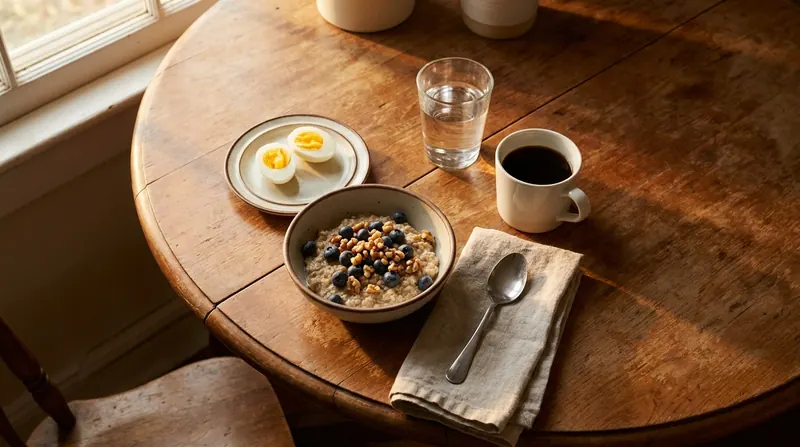
Third, the walk.
Ten minutes around the block after breakfast marks the start of the day as well as any ritual I know.
Fourth, the bag for the pharmacist, once a year, with everything in it.
None of these is exciting, and none of them tastes like anything from the cooler.
But if the morning ritual is what you are really after, these four are where I would start.
Water, the plate, the walk, the bag for the pharmacist. Then, if you like, the spray.
If You Decide to Try It
If, after all of this, the spray still appeals to you, here is how I would go about it.
- Order one bottle from the store that ships to you, and look at the full total at checkout.
- Keep it sealed until you are sure, because only sealed bottles can go back.
- Keep it high or closed if there is a dog in the house.
- Take five presses a day, at whatever hour suits you, and no more.
- Leave your coffee as it is: the spray neither adds to it nor stands in for it.
- Judge it after the month as what it is, a flavored habit with a little vitamin B5, not as a stimulant.
That is a fair trial for a bottle like this.
It asks for a month, a little money and a clear head about what is and is not inside.
Every ingredient on this spray's label, with the amount it gives for five presses and what the published studies used, is set out in the ingredient guide linked at the foot of this page.
That guide also carries the cautions, the references in full and the disclosures this page is required to make.
A month of Swiss mornings that taste like the cooler aisle
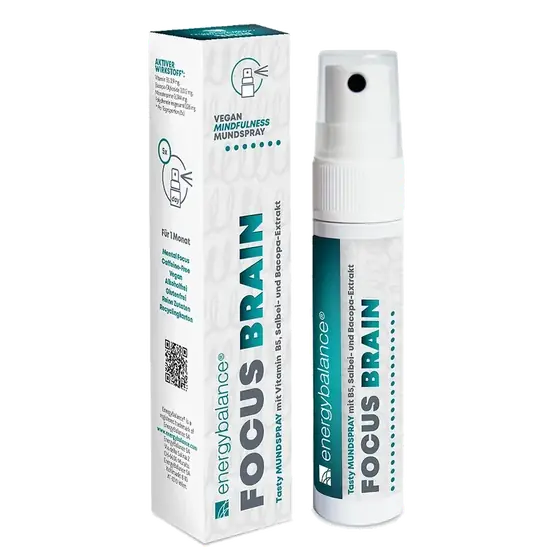
A sugar-free, caffeine-free, alcohol-free spray with vitamin B5 and small amounts of sage and bacopa extract, five sprays into the mouth once a day, in a 25-milliliter bottle made in Switzerland.
SEE THE SWISS SPRAY AND ITS LABELSold by EnergyBalance SA, Muralto, Switzerland · 25 ml, about 150 presses, five a morning for about a month · no caffeine, no sugar, no alcohol · the European store ships only inside the EU; outside it, the seller sends you to its Swiss store · no refund promise; only sealed bottles can be returned
What People Ask Me About the Spray
Seven questions from the kitchen table
Does it have any caffeine?
None. The label prints the words "Caffeine-Free," and caffeine is not on its ingredient list.
Why does it taste like an energy drink, then?
The flavor is borrowed from that kind of drink. The sweetener, a flavoring and citric acid make the taste; the caffeine is simply not there.
Can it replace my morning coffee?
No. The alertness coffee brings comes from its caffeine, and the spray has none. [2]
Is it medicine?
No. It is a food supplement made in Switzerland, and its label says it is not a medicinal product.
Is it a problem if I have a dog?
It can be. Xylitol is dangerous for dogs, so the bottle belongs somewhere high or closed. [7]
How long does one bottle last?
About 150 presses at five a day is about thirty days.
Can I send it back if I change my mind?
Only sealed, unopened bottles can be returned, within fourteen days and at your own shipping cost. There is no refund promise for an opened bottle.
When the Lamp Goes Off
By the time I finished this reading, the window over the sink had gone from dark blue to pale gold.
I reached over and switched the lamp off, the way I do every morning at about half past seven.
The mug was empty.
It had done its job, the way it always does, with its hundred-odd milligrams of caffeine.
The spray, had I been using it, would have done something much smaller.
A sweet, tart taste, a vitamin at the amount that earns its European sentence, and two herbs in amounts too small to compare with their studies.
There is nothing dishonest about that bottle, as long as the man holding it knows what it is.
It is a flavored morning habit from a real company in Switzerland, with no caffeine, no sugar and one careful sentence on the box.
If that is what you want, it is exactly what the label says you will get.
If you want the can's effect, you will find it in the mug, not in the bottle.
Five presses, no caffeine, and a parcel from Lake Maggiore
A sugar-free, caffeine-free, alcohol-free spray with vitamin B5 and small amounts of sage and bacopa extract, five sprays into the mouth once a day, in a 25-milliliter bottle made in Switzerland.
SEE THE SWISS SPRAY AND ITS LABELEnergyBalance SA, Via della Salina 2, Muralto, Switzerland · +41 91 942 88 88 · hello@energybalance.com · outside the EU, orders go through the seller's Swiss store · sealed bottles only for returns
P.S. If you keep one thing from this page, keep the difference between a taste and a dose.
The taste on this bottle comes from the cooler aisle.
The dose that wakes you up is still in your mug.